Obla Reveals Why Idoma Has Failed to Produce Benue Governor in Nearly 50 Years
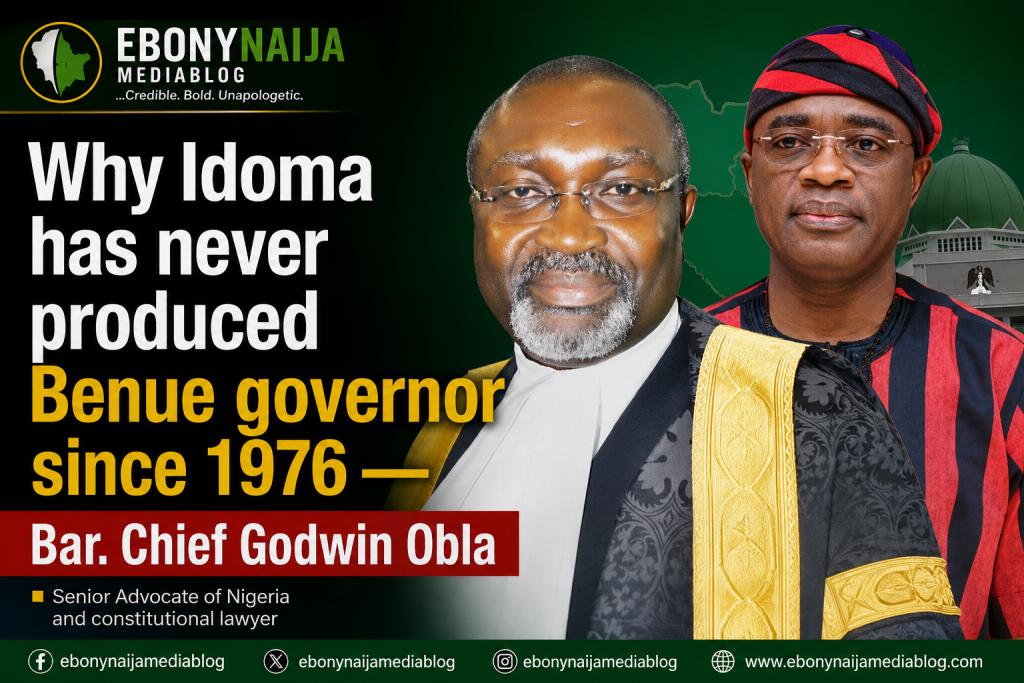
A Senior Advocate of Nigeria (SAN) and founder of the Godwin Obla Foundation, Chief Godwin Obla, has attributed the inability of the Idoma people to produce a governor of Benue State since its creation in 1976 to a combination of demographic disadvantage and deep-rooted political divisions among the Idoma elite.
Obla made the remarks on Saturday while delivering a centenary lecture titled, “The Political Choices of the Idoma People Since 1950: Context, Consequences, and the Path Forward,” during the Idoma Centenary Plus Celebration in Otukpo, Benue State.
According to him, although the Idoma are the second-largest ethnic group in Benue State, they have remained shut out of the state’s highest political office for almost five decades.
“Since the creation of Benue State in 1976, no Idoma person has ever been elected governor. Nearly fifty years of statehood have passed, yet the second-largest ethnic group in the state has never occupied Government House in Makurdi,” Obla stated.
He explained that the political structure of Benue State places the Idoma and Igede people at a numerical disadvantage. While Zones A and B, predominantly inhabited by the Tiv ethnic group, account for 14 local government areas, Zone C, largely populated by Idoma and Igede communities, has only nine.
“The arithmetic is straightforward and merciless,” he said, noting that the state’s majoritarian voting system has consistently favoured the Tiv majority in governorship contests.
However, Obla stressed that population figures alone do not fully explain the situation. He argued that recurring divisions among Idoma political leaders have repeatedly undermined the group’s chances of securing the governorship.
“Whenever the prospect of an Idoma governor has emerged, the elite have often fractured along personal interests, rivalries and competing ambitions, weakening collective political strength,” he said.
He lamented that rather than rallying behind a consensus candidate, multiple aspirants frequently emerge, splitting votes and reducing the community’s bargaining power.
Obla further criticised successive generations of Idoma political leaders for failing to translate national political influence into tangible development within Idomaland. While acknowledging that several Idoma sons have occupied prominent national positions—including Senate President, federal ministers, military governors and diplomats—he noted that many communities in the region still grapple with poor infrastructure, insecurity and underdevelopment.
“The truth we must confront is that national political prominence is not a substitute for local development,” he stated.
To address the challenge, Obla called for the establishment of a permanent, non-partisan Idoma Political Consultative Forum to build consensus ahead of elections and prevent the divisions that have historically weakened the community’s political aspirations.
He also urged greater investment in voter education, grassroots mobilisation and cross-ethnic political alliances capable of attracting support beyond Zone C.
According to him, the emergence of an Idoma governor will depend on strategic coalition-building, political unity and a development agenda that resonates across all parts of Benue State.
Describing the Idoma Centenary Plus Celebration as a moment for reflection and renewal, Obla challenged the younger generation to play a more active role in shaping the future of the ethnic nationality.
He maintained that the next chapter of Idoma political history must be driven by unity, strategic planning and collective action rather than internal rivalry and missed opportunities.
Follow EbonyNaija MediaBlog for more