
EXPLAINER: The Claim that COVID-19 Was Not Real in Benue Is False — Data, Deaths and Evidence Tell a Different Story
BY: Ogwu Shedrack (EbonyNaija MediaBlog)
At the height of the pandemic, claims circulated widely across Benue State suggesting that COVID-19 was not real, exaggerated, or a political fabrication.
This wasn’t just talk it influenced behaviour in communities across Benue State, where many people ignored safety measures, resisted testing, and doubted vaccines.
Health experts warn that such misinformation directly weakens public health response and puts lives at risk.
- Studies show fake news significantly worsened the COVID-19 crisis in Nigeria by spreading confusion and false beliefs. Fake news
MY FINDINGS AGAINST THE CLAIMS
The claim that COVID-19 was not real in Benue is false.
1. Verified Cases in Benue State
Official data from the Nigeria Centre for Disease Control (NCDC) confirms that:
- Benue recorded confirmed COVID-19 cases and recoveries
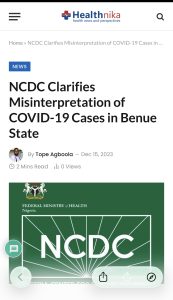
- At least 182 confirmed cases and 440 recoveries were documented in official reports (including backlog data)
Even as recent as 2023, surveillance still recorded new COVID-19 cases in Benue, proving continued presence of the virus. Source
👉 This directly contradicts claims that the virus “never existed” in the state.
2. Real Public Health Response in Benue
COVID-19 triggered coordinated health interventions in Benue:
- Public awareness campaigns via radio, TV, SMS, and social media
- Emergency response coordination between federal and state authorities
A study on Benue residents confirms that these communication strategies were widely deployed to combat the pandemic and inform citizens. Source
👉 Governments do not mobilize this level of response for a “non-existent” disease.
3. Vaccination Campaigns Across Communities
Evidence shows that:
- Mobile vaccination teams were deployed across multiple LGAs in Benue
- Over 150 teams worked in communities to increase vaccine uptake Source
👉 This large-scale intervention further confirms that COVID-19 was treated as a real and serious health threat.
4. Misinformation Was Already a Known Problem
The NCDC itself acknowledged that:
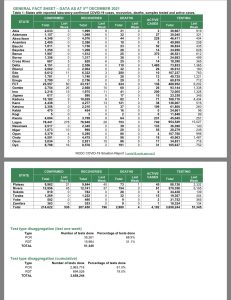
- There was widespread misinformation in Nigeria questioning the existence of COVID-19 Source
Screenshot
👉 Meaning: the “COVID is not real” narrative was part of a documented misinformation wave not reality.
Why the False Claim Spread in Benue
Evidence points to several drivers:
- Distrust in government
- Influence of public figures downplaying the virus
- Heavy reliance on WhatsApp and social media rumours
- Limited access to verified information in rural areas
Research confirms that misinformation in Nigeria spread rapidly through digital platforms and informal networks. Source
Human Impact (Stronger Story Angle)
Behind the data are real consequences:
- People ignored preventive measures
- Some refused testing or treatment
- Vaccine hesitancy slowed response efforts
👉 In a public health crisis, belief can be as dangerous as the virus itself.
Conclusion
The claim that COVID-19 was not real in Benue State is false and misleading.
- Verified cases were recorded
- Public health systems responded
- Vaccination campaigns were implemented
- Misinformation was officially documented
The evidence clearly shows that COVID-19 was real, present, and impactful in Benue State.
✅
Verdict: FALSE
Combating narratives like this is critical. Organisations like the Centre for Democracy and Development continue to train journalists and citizens to identify, debunk, and prevent the spread of misinformation, especially in vulnerable communities.
This piece was produced in collaboration with the Centre for Democracy and Development (CDD-West Africa) as part of its Media Fellowship.
#CDDWestAfrica #TruthNaPower #fightfakeNews #VerifyBeforeYouShare